Street trees to zoning rules: November ballot measures
Albany has six ballot measures that would change zoning rules, business and property taxes, and funding for city services.
Albany voters will decide on six ballot measures in November covering zoning authority, infrastructure and public safety funding, business taxes, property transfer taxes, and funding for street trees and lighting.
Measures O through T would make changes to existing city policies and taxes or establish new funding mechanisms. Here's a look at each measure.
Note: The deadline for filing arguments against the measures is Friday, Aug. 14, at noon. The deadline for filing rebuttals is the next Friday, Aug. 21. The city has posted instructions.
Measure O: Single-family zoning
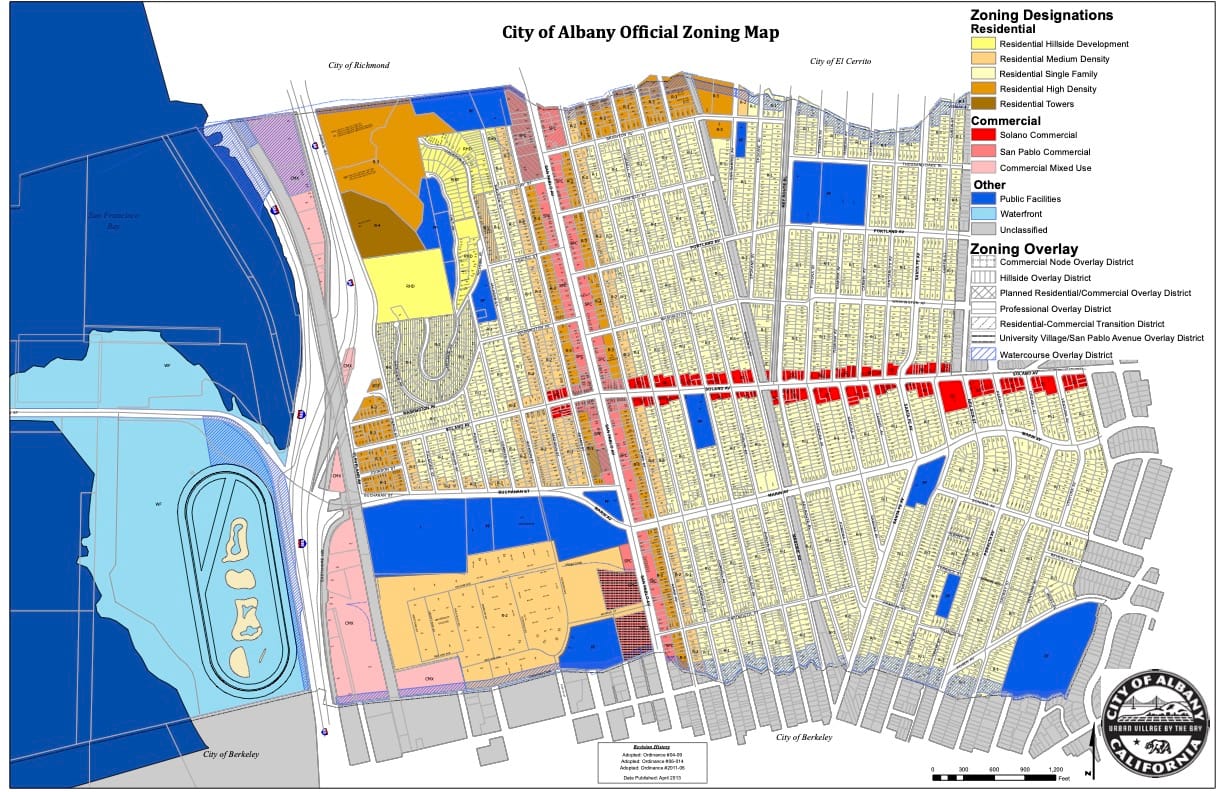
Measure O would change rules established by Albany’s 1978 Measure D governing zoning changes in areas designated R-1, or single-family residential, which covers roughly 440 acres of the city.
Measure D currently gives residents in R-1 a role in approving certain zoning changes. Under Measure O, the City Council would be able to amend those zoning requirements without obtaining majority approval from residents in the affected neighborhood, provided the council follows the public hearing and zoning procedures required under state law.
The city’s Strategic Plan includes an objective to "Develop [a] ballot measure to update the City Council’s authority to consider changes to single family zoning standards," referring to Measure D.
The current zoning designation primarily allows one detached single-family dwelling per lot, along with state-compliant housing options such as accessory dwelling units and certain split-lot and duplex developments permitted under Senate Bill 9.
A yes vote on Measure O would give the Albany City Council greater authority over zoning in single-family residential areas and reduce the direct approval power granted to neighborhood voters under Measure D.
Measure P: Street Paving and Storm Drain Special Parcel Tax
Measure P would amend Albany’s existing Street Paving and Storm Drain Special Tax, which voters approved in 2006.
The most significant change would only be triggered if a parcel of at least 500,000 square feet is sold, leased or transferred to make it tax exempt.
A yes vote would allow the city to levy a tax of up to $0.0638 per lot square foot on all parcels, with a CPI adjustment up to 3%. Until that happens, the existing tax of $167.65 would remain in place but the CPI cap would be lowered from 5% to 3%.
The measure would also add a 100% rebate for qualifying very low-income renters and a 50% exemption for qualifying homeowners.
The tax is estimated to generate $1.4 million annually.
Measure Q: EMS, Advanced Life Support and Fire Protection Special Parcel tax
The measure, if approved, would include amendments to the city's existing parcel tax (Measure K from 2022), providing exemptions for very-low and low-income homeowners and rebates for renters.
As with Measure P, the most significant change would only be triggered if a parcel of at least 500,000 square feet becomes tax exempt through sale, lease or transfer.
A yes vote would change the assessment from a tax based on land area to $0.254 per building square foot for developed property and $0.110 per lot square foot for undeveloped property.
The current rate is $0.0807 per lot square foot.
The tax is estimated to generate $2.5 million annually, which would fund emergency medical, advanced life support and fire protection services.
It would be annually adjusted by the Consumer Price Index.
Measure R: Business License Tax
Measure R would change how Albany calculates its business license tax.
Currently, the tax is calculated based on the number of employees. Under Measure R, the tax would instead be based on a business’s gross receipts, or revenue.
The change would affect businesses differently depending on their revenue and staffing levels. Businesses with higher revenues and relatively few employees could pay more under the new system, while businesses with lower revenues could pay less.
Revenue collected from the tax, providing an estimated additional $600,000 annually, would support Albany general services, such as fire protection, public safety, environmental and community service programs.
Measure S: Real Property Transfer Tax
The measure, if approved, will adjust the real property transfer tax from an across-the-board 1.5% rate to a five-tiered rate structure, from $15 to between $10 and $30 per $1,000 purchased, depending on the property’s purchase price.
It would provide an additional $1 million annually that would support general services, including street and park maintenance, recreation, public safety and environmental programs.
Measure T: Street Lighting and Trees Special Parcel Tax
Measure T would establish a new special parcel tax to fund the improvement and maintenance of Albany’s street trees and street lighting.
The measure would establish a rate at $0.0354 per taxable lot square foot commencing July 1, 2027 if approved. Only the first 500,000 lot square feet of a parcel would be subject to the tax, which would fund tree planting and maintenance, management of aging or hazardous trees, and improvements and maintenance for street lighting.
Revenue from the tax, expected to provide an estimated $775,000 annually, would be restricted to those purposes rather than placed in the city’s general fund.
Correction: This story originally misstated how Measure P and Measure Q would work. This has been corrected.
We'd love to hear which measures you want to know more about. We also welcome guest essays from community members on issues of concern. Have other questions for Albany Scanner, or want to share tips? Here's how to reach us.